Immigrate to India
Planning to move to India permanently? Learn about entry visa requirements, the visa types available and the steps to relocate, with help from our lawyers.
Individuals who immigrate to India relocate to this country for permanent purposes. If you are ready for this step, our lawyer in India can assist you throughout the process.
| Quick Facts | |
|---|---|
| Entry visa requirement (from EU) (YES/NO) | Yes |
Entry visa requirement (outside EU) (YES/NO) | Yes |
Types of visas available | Tourist Employment Business Research Conference Transit Medical |
| Time frame for obtaining work visa (approx.) | Minimum 3 working days |
| Validity of temporary residence permit | Extended up to 5 years, depending on type |
| Time frame for obtaining permanent residence (approx.) | Permanent Residency Status available to foreign investors, residency granted for 10 years (extendable), minimum processing time: 3 days. |
| Investor Visa Availability (YES/NO) | Yes |
| Sponsorship requirement (YES/NO) | No |
| Time frame for obtaining citizenship | 12 years Dual citizenship not permitted |
| Citizenship/Residency by investment scheme availability (YES/NO) | Yes |
| Tax benefits for expats | Tax credit on foreign income, subject to conditions. |
| How to obtain citizenship | – by birth, – by descent, – by registration, – naturalization. |
Naturalization process | – pass the residency requirements, – show good character, – pass language test, – renounce previous citizenship (if applicable), – submit application, – take oath of allegiance. |
Residency requirements | Reside in India for at least 11 out of the last 14 years before applying for citizenship; Live continuously in the country for one year immediately before submitting the application. |
| Overseas Citizenship of India | A special immigration status granted to individuals of Indian origin living abroad; Is a long-term visa that allows multiple entries into the country. |
| Persons of Indian Origin | A predecessor of the Overseas Citizenship of India, which is no longer available. |
| Can buy property (YES/NO) | YES, but only under long-term visas or residence permits. |
| Cases for citizenship by registration | – be a person of Indian origin ordinarily resident in India for 7 years, – be married to an Indian citizen and ordinarily resident in India for 7 years, – individuals with Indian parents, – be an overseas citizen of India for five years and reside in India for one year, etc. |
| Documents required for immigrating | – passport, – visa, – proof of residence, – proof of sustainable income, – letter of invitation (if applicable), etc. |
| Special documents needed for | – employment, – study, – employment for business. |
| Immigrating with pets | – microchipping is mandatory, – obtain license of import for pets, – respect vaccination protocols, – obtain certificate from the Animal Quarantine and Certification Station. |
| Importing personal belongings | – hold a valid visa, – must be shipped within 30 days of the individual’s arrival in the country, – physical presence required during custom verification. |
| Free of charge imported items | – clothes, – books, – furniture, – kitchenware, – small appliances, – computer, – laptop, – video cassette player, – washing machine, – domestic refrigerators, – cooking ranges (under certain conditions). |
| Reasons to immigrate | – work opportunities, – investment, – study, – culture and spirituality, – family reunification, – personal reasons, etc. |
| Advantages of immigration to India | – economic opportunities, – exploring the culture, – affordable cost of living, – low taxes, – investment potential, etc. |
| Assistance from our Indian lawyers | Our law firm in India can provide support for immigration matters. |
Who can move to India?
Our lawyers in India present the following scenarios:
- Foreign nationals of non-Indian origin may relocate to India based on a long-term residence permit, issued and renewed accordingly, as per a specific reason for stay. Citizenship by naturalization is possible, provided that the applicant follows specific conditions;
- Permanent residency for non-Indian foreign nationals is also granted for making a significant investment (see below for details).
- Individuals who are overseas citizens of India (they have Indian ancestry, subject to conditions) may receive indefinite permanent residency rights.
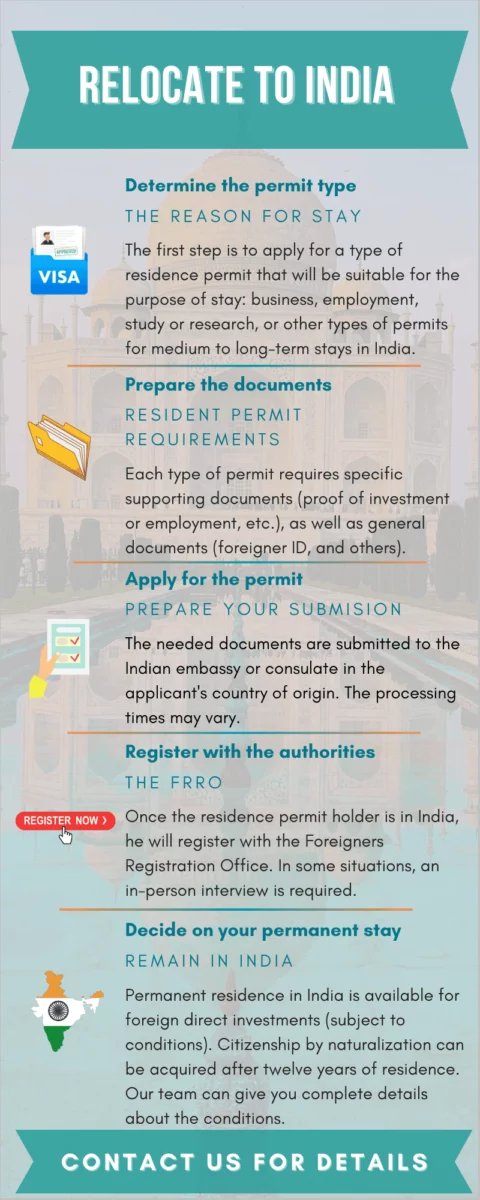
What documents do I need to immigrate to India?
The following list of documents is generally requested:
- Passport;
- Visa;
- Notice of place of residence (a valid address);
- Proof of subsistence income;
- Letter of invitation.
In addition to these, your application will also include visa-specific documents. Examples include:
- for employment: a copy of the employment agreement which includes important details on the employment relationship (job, salary, etc.);
- for employment or business: a forwarded letter from the company with which the visa holder will work, signed by the company’s representative;
- for study purposes: copies of the documents from the school, college, or other educational institution proving the admission of the individual and his or her nationality.
What types of visas are available to those who immigrate to India?
Foreign nationals may choose to relocate to India for several purposes; however, they will have to do so based on a visa that can be used for long-term stays (longer than 180 days). The following options are available:
- Study;
- Research;
- Employment;
- Business.
Foreign nationals who enter India are required to register and, at the time of the registration, one will be issued a residential permit. This permit has the same duration as the visa.
The visa issued for a specific purpose can be extended, thus essentially allowing the holder to remain in India for long-term purposes and, finally, to meet the requirement for citizenship and to immigrate to India.
What are the general requirements for those who relocate to India?
Remaining in India for permanent purposes is possible when the foreign national meets a set of specific criteria. These include:
- Compliance with the lawful requirements for remaining in the country. This means that the foreigner must always have a valid residence permit. Only after several years can they apply for the right to remain in the country indefinitely;
- Having sufficient income, which may be regular income from employment, or income derived from investment (can differ according to the type of residence permit);
- No criminal record;
- Lawful conduct during one’s stay;
- Economic contribution (either via employment and the payment of the due taxes or via business ventures and the creation of jobs, along with the payment of due taxes).
Please keep in mind that these are general requirements which may be detailed upon request by our team. Permanent residency, such as required for those who ultimately want to immigrate to India, is granted only after careful consideration and according to law.
We invite you to watch the following video on the process to immigrate to India:
How can I immigrate to India as a foreign investor?
One of the surest routes to gaining permanent residency status, also referred to as PRS in India, is via a significant investment.
This is available to those who want to immigrate to India and meet the following requirements:
- They make a minimum investment of Rs. 10 crores within 18 months or Rs. 25 crores within 36 months (via an accepted foreign direct investment route);
- Their investment creates employment for at least 20 resident Indians (during every financial year).
This option is not available to Pakistani nationals or third-country individuals of Pakistani origin.
A foreign investor who follows this route to immigrate to India has the following advantages:
- Their permanent residence status is granted for 10 years, with the option to renew it for another ten;
- They are not subject to minimum stays or restrictions on entry;
- They can bring their spouse and/or dependants;
- They can buy property in India for residential purposes.
How can I obtain Indian citizenship for immigration purposes?
As a foreign national of non-Indian origin, you may apply for citizenship by naturalization if you have been residing in the country lawfully for at least 12 years before submitting your application.
Adult foreigners married to an Indian citizen who have been residing in the country for at least seven years may also choose to make their stay permanent.
Contact us for more information on how you can move to India and to better understand your options.
Gaurav Vashistha, Lawyer · 2 October 2026